thwack

thwack

FOXLEY REDUX by Benjamin Soileau

Benjamin Soileau author photo

Benjamin SoileauFOXLEY REDUX Foxley’s uptight on the glass, watching for the hard silver wink of Daddy’s Bronco. Mama said his ass was grass. He heard her on the phone tattling and when she brought it to him and he put…

GARE DU NORD, 1988 by Kim Magowan

Kim Magowan author photo

Kim MagowanGARE DU NORD, 1988 The girl escorts her boyfriend to Gare du Nord, where he will take a train to the coast and then a ferry back to England—this is years before the Chunnel will be built. He is…

EIDOLON by Nicole Greaves

Nicole GreaveEIDOLON She said there are some things you will always be, like Italian, some skills interchangeable:  folding underwear and trussing a chicken, some days for darkness.  I remind her of her dead daughter.  Her true character! Everything is a…

A WORLD BETWEEN, a novel by Emily Hashimoto, reviewed by Ashira Shirali

A World Between book jacket

A WORLD BETWEEN
by Emily Hashimoto
Feminist Press, 440 pages
reviewed by Ashira Shirali
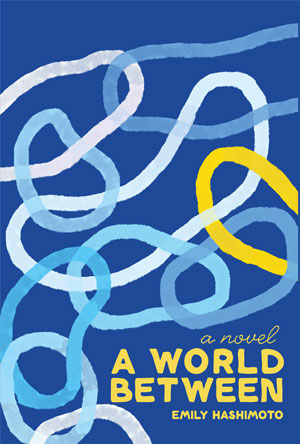
A World Between book jacketLet’s be honest—the chances of walking into a bookstore and finding a literary lesbian romance are low. You’re more likely to find an entire cookbook consisting of sourdough recipes. If you want the book to feature characters of color, your odds sink even lower. Emily Hashimoto’s debut novel promises to fill this lacuna. A World Between (Feminist Press, forthcoming) follows the relationship between two women of color, Leena and Eleanor, through college and adulthood. The novel alternates between Leena’s and Eleanor’s perspectives, revealing the yearnings and anxieties of each as they grow apart and together.

There is much to marvel at in this debut. Hashimoto is adept at plotting. She pulls Leena and Eleanor apart with narrative developments that are both unexpected and believable. The novel heightens tension as we long for the two’s reunion despite circumstances, family expectations and their own struggles. Eleanor and Leena’s conflicts are heartbreakingly realistic. Their fights remind us that in real life there are no villains or heroes, just two people whose earnest feelings clash. Hashimoto deploys details masterfully. She can bring characters to life with just a handful of words. When Leena cries in her mother’s car, she turns away because her mother “couldn’t stomach emotions of this magnitude.” The novel’s dialogue captures the rhythms of young people’s conversations, both the beat and the crescendos.

A World Between’s greatest triumph is capturing the shape, color and texture of attraction between two women.

Despite these strengths, Leena and Eleanor’s honest, multi-stranded story is let down by the novel’s prose. Hashimoto’s similes fall flat as often as they succeed, and she pushes metaphors too hard. After describing how Leena responds to Eleanor’s body as if calculating an equation, Hashimoto writes, “If two trains were headed to Boston at one hundred miles per hour, how fast would Eleanor come?” There are awkward phrases which aspire to the literary (“she took bite of her tongue”), and sometimes the writing elicits pure confusion (“the streets where bars hummed and clothing wore her fellow New Yorkers”). The novel could easily lose a hundred pages. In other places, however, the words delight—“It was quiet for a long time, dust settling on the ellipses of the moment.”

GARDEN BY THE SEA, a novel by Mercè Rodoreda, reviewed by Anthony Cardellini

Garden by the Sea book jacket

GARDEN BY THE SEA
by Mercè Rodoreda
translated by Martha Tennent and Maruxa Relaño
Open Letter Books, 203 pages
reviewed by Anthony Cardellini

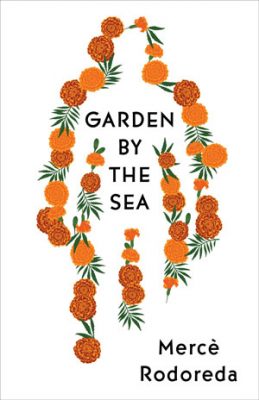
Garden by the Sea book jacketWhen I began my part-time job at a botanical garden in the fall of 2017, I had next to zero gardening experience, and I knew little about the different flowers and trees that grow in the Piedmont region of North Carolina. I showed up that first day completely unprepared, without so much as a pair of gloves. But I was lucky enough to be mentored by David, a man in his early thirties from Maine, who’d been gardening for several years. David explained to me the paradoxical nature of caring for gardens: gardens need constant attention, but they bear their beautiful fruits ever so slowly. At the heart of David’s message was that gardeners are transitory, but gardens remain. Our decades are their hours.
LITTLE ENVELOPE OF EARTH CONDITIONS, poems by Cori A. Winrock, reviewed by Charlotte Hughes

Little Envelope Cover Art.jpg

LITTLE ENVELOPE OF EARTH CONDITIONS
by Cori A. Winrock
Alice James Books, 85 pages
reviewed by Charlotte Hughes

Little Envelope Cover Art.jpgI read Little Envelope of Earth Conditions in late June, when COVID-19 cases were skyrocketing in the world and the nation—and at home. The May 24th New York Times front page, which listed the names of the 100,000 American coronavirus victims—a very public display of mourning and grief—was at the forefront of my memory, as were the more personal ways that I was mourning the loss of traditions, previous ways of life, time spent with grandparents and my fellow high school students alike.
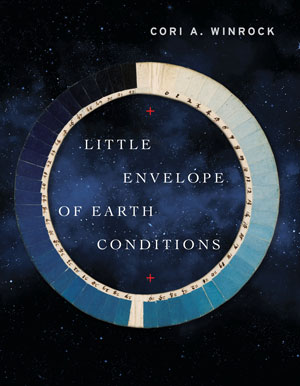
Throughout her second collection of lyric poems, Little Envelope of Earth Conditions, Cori A. Winrock explores the experience of mourning: specifically, the idea that grief is an ongoing, recurring experience that never truly goes away. It is simultaneously universal and intensely personal. She tells a compelling narrative about the loss of a mother and child, spanning from the vast emptiness of space to an ambulance in a parking lot to a placid meadow on the edge of a lake. The

Cockfight, stories by María Fernanda Ampuero, reviewed by Ashley Hajimirsadeghi

cockfight book jacket

Cockfight
by María Fernanda Ampuero
translated by Frances Riddle
Feminist Press, 128 pages
reviewed by Ashley Hajimirsadeghi

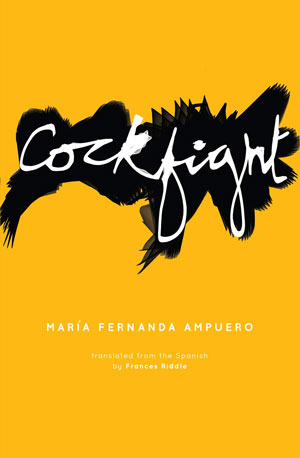
cockfight book jacketIn her debut novel, Ecuadorian writer and journalist María Fernanda Ampuero takes an unflinching and intimate look into the turbulent homes and lives of Latin American women. By placing her powerful, moving stories in settings like violent domestic households or lower income neighborhoods, the characters in Ampuero’s Cockfight combat their situations with acts of bravery, loss, and love. As the characters seem to suffocate in their environments, there are acts of bravery, loss, and love. The idea of a happy family is a myth and men are depicted as lecherous, terrifying creatures of the night. The narrators often are maids, young girls, and women wrenched into horrifying situations such as forced incest, rape, and human trafficking.

TIGERS, NOT DAUGHTERS, a young adult novel by Samantha Mabry, reviewed by Kristie Gadson

Tigers Not Daughters book jacket

TIGERS, NOT DAUGHTERS
by Samantha Mabry
Algonquin Young Readers
288 pages
reviewed by Kristie Gadson

Tigers Not Daughters book jacketSamantha Mabry’s Tigers, Not Daughters is a modern-day ghost story that follows the Torres sisters—Jessica, Iridian, and Rosa—one year after the untimely death of their oldest sister, Ana. Wracked with grief, the Torres sisters ache for Ana; but their profound sadness is met with unexpected events that eventually make their sister’s presence known: raps on doors and windows, writings on the walls, sensory overload, recurring storms, flickering lights, dying animals, and one escaped spotted hyena lurking in the darkness of their neighborhood in Southtown. Ana reappears in a way the girls can’t begin to imagine and returns with a vengeance they don’t understand. Mabry tells a riveting tale of three sisters who discover the power of sisterhood and what it means to stay together despite insurmountable, unnatural odds.
What stood out to me while reading Tigers, Not Daughters was how colorful and tangible each of the Torres sisters is. Their characterization is well-rounded, Mabry vividly telling the story through the individual perspectives of each sister, as well as including a fourth perspective of a character that watches them from afar. Each sister is unique in not just who they are, but in how they grieve over the loss of Ana.

THE SPORT OF THE GODS, a novel by Paul Laurence Dunbar, reviewed by Dylan Cook

The Sport of the Gods book jacket

THE SPORT OF THE GODS
by Paul Laurence Dunbar
Signet Classics, 176 pages
reviewed by Dylan Cook

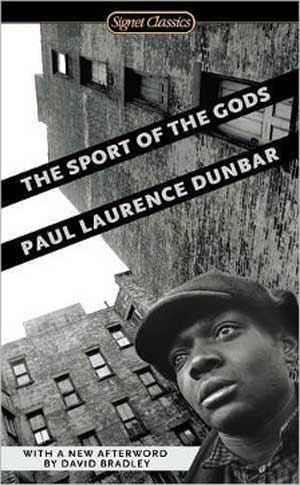
The Sport of the Gods book jacketFor the best experience, I recommend reading The Sport of the Gods outside on a cloudy day, rain threatening. As you fall in step with Paul Laurence Dunbar’s rhythmic prose, it’ll be easy to forget that you’re at nature’s mercy. Let the clouds decide whether or not you get to read uninterrupted. Subject to this force, you may more easily understand what the Hamilton family endures in this novel. As deceits and misfortunes pile on top of each other, the Hamiltons decide that nature can’t help but rain down upon them. Their breakdown is more than plain bad luck can explain, so they know that they are fighting, “against some Will infinitely stronger than their own.”

Even if you haven’t heard of Paul Laurence Dunbar, you’ve likely read lines of his poetry. Maya Angelou immortalized his poem “Sympathy” when she borrowed a line for the title of her memoir I Know Why the Caged Bird Sings. Discussing her influences, Angelou lauded Dunbar in the same breath as Shakespeare. Dunbar was born to former slaves in Ohio in 1872, right in the middle of the Reconstruction era. He began writing seriously as a teenager, the only Black student in his high school. He had some early publishing help from his friends Wilbur and Orville Wright (yes, those Wright Brothers) before publishing his first poetry collection, Oak and Ivy. From this collection’s success, Dunbar launched a prolific career that spanned over a dozen poetry collections, three short story collections, and a handful of novels. In nearly all of his work, he seamlessly transitioned between standard and vernacular English, a feat that earned him both praise and criticism. Perhaps most miraculously, he produced all of this work amid recurring bouts of tuberculosis and alcoholism. Dying at the age of 33, Dunbar left behind a sprawling body of work that’s yet to be properly explored.

CLOTEL OR THE PRESIDENT’S DAUGHTER, a novel by William Wells Brown, written in 1853, reviewed by Dylan Cook

Clotel book jacket

In 1998, scientists performed a DNA test to answer one of the longest running rumors in American history. Historians could no longer deny the truth: Yes, Thomas Jefferson had fathered children with his slave Sally Hemings. But plenty of people already knew that. William Wells Brown knew this beyond a reasonable doubt when he published Clotel in 1853, a novel that imagines the lives and tribulations of Jefferson’s slave-born daughters. The characters are all fictional, but Brown’s creative liberties stray little from reality. Masters frequently made concubines of their slaves, so why would Jefferson be any exception? Jefferson’s words that “all men are created equal” were a farce in Brown’s eyes, because only in antebellum America could a president’s daughter be born in chains.

THE DARK HEART OF EVERY WILD THING, a novel by Joseph Fasano, reviewed by Michael McCarthy

In the moral universe of poet Joseph Fasano’s debut novel, The Dark Heart of Every Wild Thing, death lurks in every corner of life. A father, bereaved of his wife, must journey through the teeming forests of British Columbia and hunt a fabled mountain lion, to him the very “mind of the wild.” Three years ago, it mauled his son, the father powerless to save him. Now, as he narrates his monomaniacal fight for survival, the hunt for the mountain lion becomes an obsession, borne of unfathomable grief, to exact revenge on a world that has stolen everything he loved.

ON EARTH WE’RE BRIEFLY GORGEOUS, a novel by Ocean Vuong, reviewed by Claire Kooyman

Ocean Vuong’s writing is steeped in memories, the history of which sometimes precedes him chronologically. This was true of his poetry in the collection Night Sky With Exit Wounds, and it is also true of his first novel, On Earth We’re Briefly Gorgeous, recently released by Penguin Press. This novel is a recursive exploration of the path memories take through a family. The narrator’s life is impacted by the traumas his mother and grandmother suffered before he was born. As a very young child, Vuong’s narrator, Little Dog, learns quickly that not all authority figures can be trusted absolutely, and that even unconditional love has flaws. Throughout the novel, Vuong illustrates that we are all sharing space with the past, even as we exist in the present.

AN INTERVIEW WITH MIKE AVERY, AUTHOR OF THE COOPERATING WITNESS, by Andrea Caswell

The Cooperating Witness book jacket

In Mike Avery’s debut novel, an ambitious law student is determined to find the truth to save an innocent man accused of murder. But the truth is never black-and-white, and the secrets she discovers hit close to home. The Cooperating Witness is a compelling legal thriller in which the moral ambiguities of justice are on trial. Mike Avery mines his fifty-year career as an attorney and law professor to craft a suspenseful story of murder, the mob, and a young woman’s determined idealism. In the following interview, conducted via phone and email, the author discusses his novel, the freedom of writing fiction, and the complex intersection of our legal system and morality.

IN THE WOODS by Emily Steinberg

IN THE WOODS

Mid-June. It's cool. It's quiet. the sun-dappled path is rugged and craggy and I've been walking it one or another for 55 years. Gus pulls me along, his pantaloons jauntily swaying in the breeze, stopping at each watering hold with expectant, happy eyes. In here, I don't have to think about 115,000 dead. In here, I don't have to think about a 27-year old shot in the back in a Wendy's parking lot or a 46-year old dying with a knee on his neck after 9 minutes...

SOME BRIEF THOUGHTS ON SELF-IMPROVEMENT by Reilly Joret

My wife fingered the remaining chocolate syrup from her bowl to her mouth and announced she was going to bed. I’ll admit The Tonight Show monologue that night wasn’t going to change her mind. It was all obvious punchlines about the president’s Asia trip, with some cheap shots at the end for the congressman with the Honduran mistress maid, and the reality TV star with the unflattering DUI mugshot. I feared this was becoming the norm. I followed my wife upstairs, hoping we might discuss this unsettling trend, or get in something cursory between the two of us, but she fell asleep in a way that suggested a medical condition.

ENGAGED by Susan Tacent

Susan tacent author photo

You scratch because it itches. You’re over the moon with excitement. Good news always drives your histamine reaction and now you’re breaking out in hives. You drink a glass of water. You breathe, slow breaths, in, out, the way the yoga teacher and the meditation guru and the homeopathist and the ENT guy instruct. The itch gets funky, like a dance, up and down your arms, the backs of your thighs, a place between your shoulder blades you can’t reach. You ask Ben to reach for you and he says he won’t because scratching only makes it worse. If you’re going to marry this guy, you want to know. You tell him he has to and when he does, you know you made the right choice.

NORTHWEST STALKER by Jan Stinchcomb

The truth is, she misses everything from those days, the skirts they wore and the bangs they had, side swept, always on the verge of disappearing, like youth. Like life. It all slipped away, as her parents had warned her, even the people. Girlfriends you thought you’d have forever, poof, lost to marriage or motherhood or minds suddenly changed. They didn’t want to be girls anymore. They moved to other states. They changed their names and lost themselves.

TWO POEMS by Jaewon Chang

Blindness

It began with a stove,
burnt mahogany dissipates in, wishing
the ember hinted the future: mother
running out of her favorite house,
home to the ancestors’ cedar trees. She had one last look
at her bedroom door, the one grandfather
painted pink, now dark red. I could only recall

SPECIFIC AIR by Rebecca Titus

It is midnight in early March and you are pacing the wood floors of your sweet, single-story house in East Nashville—a place with a pair of red-tailed hawks in the front yard and a pair of train tracks in the back. You are on the phone with your musician-botanist-projectionist friend, comparing the vibrant gardens of your childhood to coral reefs. Before it sold, she saw your parents’ house for herself last summer: the lightning bugs, the flowering vines, the fractal canopy suspended above the creek. She gets what you mean about the flowers. You jot down some notes, hang up, and go fill a water glass. You catch a flash of white light through the slats of your blinds and step on the back deck.

DON’T WORRY by Charles Holdefer

Squinting against whiteness the child left her mother beside the woodpile. With the sudden drop in temperature an icy crust had formed on last night’s new snow. “We’ll find it!” her mother called, watching the child walk on the surface while she stood shin-deep, clutching her stump to her breast. It was tightly wrapped in rags. Bleeding was stanched. The throbbing had slowed, perhaps due to the cold. But she was burning up, dizzy.

THE LIVING AND THE DEAD by Melissa Brooks

The world was fuzzy. Victoria blinked. She blinked again and again until the room came into focus. A pixelated ceiling. A window opening to blackness. An unkempt man slouched in a chair, fist propping up a mess of greasy dark hair. He had sallow skin, dark bags beneath bloodshot eyes. Familiar eyes. Barry’s eyes? Benny? Billy? Billy.

MATRYOSHKA by Marion Peters Denard

When Mom died Rachel started asking questions. What did Mom make for Christmas morning? Egg casserole. When did Mom go back to school? I was fourteen, you were eleven. The questions got smaller and bigger, as though by their specificity they were magnified.  What did she smell like? She wore Chanel No. 5. I know that, Tabbie. But what did she smell like?  She smelled like orange honey and coral lipstick and bright green breath mints. What did her hugs feel like? They were nice. Tabbie. Like she was bringing you in and keeping you out at the same time.

SOULS FALLING INTO HELL LIKE SNOWFLAKES by Roy Bentley

Am I the only one in the Cleveland Art Museum today
looking for mercy? I’m looking at an artwork about Hell
or the end of the world, recalling my then-small son saying,
of the Challenger disaster, I’d have gotten out. In the painting,
there are boats and the boats are filling, the sea aswarm and
starkly bullying like the first dopplered image of a hurricane.
Angels with an artist’s idea of wings are manning the tillers,
captaining across a broth of larvae-white bodies, the deltas

GRAB, SNATCH by Michelle Ephraim

The hospice nurse is gloves-and-salve practical.

She says: your mother must want something from you.

My mother can’t walk or talk. Her body is bones wrapped in reams of moth skin. Her brain works in insect twitches.

UNDONE by Elaine Crauder

The banana bread would not bake. Maddy had followed the recipe to a T, only substituting canola oil for half the butter, honey for half the sugar, skim for whole milk, and nutmeg for cinnamon. Putting on long oven mitts and pulling the door open, she checked the loaf again. Three hundred and fifty degree heat swept into the kitchen, already filled with late summer swelter. Not wanting to take the time to lift the single bread pan onto the top of the stove, she pulled out the rack, took off one mitt and stuck a toothpick into the loaf. Raising it straight up, it was plain to the naked eye—her reading glasses were sitting idle on the kitchen table—that raw batter clung to the sliver of wood for dear life. If it had been at all cooperative it would let the toothpick withdraw, leaving no trace on the twig, as if untouched by the experience.

IT’S THE END OF THE WORLD AS WE KNOW IT by Brenna Womer

While shopping what’s left of the canned goods at the grocery store, an announcement at the top of the hour, robust and autotuned: “All employees must now perform a personal temperature check,” and I, in a pair of disposable vinyl gloves but not a facemask because Dr. Gupta says they’re unnecessary for the still- and now- and currently-healthy, holding the last can of Kroger no-salt garbanzos, recall they’ve always made this announcement, but two weeks ago they were checking the temperature of the meats.

THE WOMAN IN THE DREAM by Mirande Bissell

hands the swaddled child over. A dream is no place
for a baby. She has seen revelers pour the baby
from a carafe—he’s white wine, fruity like the summer
he is born into, and they drink the baby in the purple
dusk of a dream-cafe. She’s always too late to stop them.

WALKING THROUGH THE UNDERWORLD by Stella Hayes

out my window colored heads bound in swiftness. in their decision to bring about movement

& motion. the snow is taking a break from falling, as it did just days before. the village is

painted in primordial gray, with roofs in color too happy even for a rainbow. eavesdropping

TO LIFT US UP WHEN WE ARE FALLEN by Leonard Kress

There are three women installed in the living room when I arrive. Smartly dressed, young moms most likely, with highlighted loosely curled hair, gleaming toenails, and tailored pantsuits. All have open laptops and cell phones—new information and guidelines saturate the air. I arrive with a friend because this is where our weekly writing group meets, at Hope’s house—because she’s wheelchair-bound, and can’t easily secure a ride to our usual meeting places. The women are from the hospice—nurse, social worker, and gerontologist. It occurs to me that the more they deal with the dying, the farther away they get from death. They bring a pleasing scent to the room, perfume and doughnuts and pastries, which overpower the disinfectant used to clean up after Hope’s father’s renal stent failed in the middle of the night and urine soaked into the carpet.

CLEANNESS, a novel by Garth Greenwell, reviewed by Nikki Caffier Smith

Cleanness Book Jacket

At its heart, Cleanness is a novel about duality: the duality of spirit, of desire, of self-perception. How one can be “dirty” and “clean” at the same time. With deft and expressive writing, Greenwell questions our understanding of these concepts. What does it mean to be dirty? What does it mean to be clean? To go outside or stay in. To stay in or go outside. Perhaps they are just two facets of the same thing.


AN INTERVIEW WITH SHARON HARRIGAN, AUTHOR OF THE NOVEL HALF, by Virginia Pye

Book Jacket Cover Art for HALF

Writers have a way of finding each other in Virginia, thanks to several strong literary non-profits. Sharon Harrigan teaches at WriterHouse in Charlottesville and I used to help run James River Writers in Richmond. We met years ago at the annual JRW Writers Conference. When my first novel came out, Sharon generously reached out and offered to interview me for Fiction Writers Review. I moved to Cambridge several years later, but we continued to keep track of each other’s careers, cheering on each new publication. I’m delighted to interview her now about her debut novel, HALF. In sparse, lyrical prose, it tells the story of identical twins who speak in one voice, until they can’t any longer.

WHAT I CARRY, a YA novel by Jennifer Longo, reviewed by Aja Todd

Cover art for What I Carry

From the very first moment of her existence, Muiriel was born alone. Found abandoned at a medical center with no parents to claim her, Muiriel has lived in foster care her entire life. But blessed with a book of survival by naturalist John Muir and her experience in nearly twenty different foster homes, seventeen-year-old Muiriel knows she will not let her past dictate her future:

Aging out is terrifying.

ASK JUNE: Coronavirus II: The Old Marcher and the Masked Baby

Ask June Cleaver

A note to my readers:

Here are a few more coronavirus-related letters. Knowing what I know now, I would have submitted them all at once, a few weeks ago, instead of spacing them out. Things have changed so quickly since that first batch: problems like nagging mothers and the niceties of social-distancing behavior may seem petty and quaint as compared to the deadly-serious questions and sweeping protests following the murder of George Floyd. I will submit my second batch of letters now, but humbly, in hopes that they may provide a moment of entertainment for those of you who are taking a break from weightier matters, and that they may still be of use to those of you who are still worried about contracting the virus during normal daily activities.

HARD TACK by Jamie Alliotts

It’s a damp, drizzly November night—Thanksgiving—and I can’t help but think of Melville’s famous orphan, who sets out from this insular city of the Manhattoes, goes to sea with branded Ahab, and eats hardtack with his shipmates aboard the doomed Pequod. ■ Blinky grew up on a cattle ranch in Miami. As a boy, he spent time in foster homes, on the street. He tells me about his father—then asks me to leave him out of it. Saw his mother for the first time when he was 12 or 13, around the time he started smoking crack. Saw her again—and for the last time—a few years later.

THE BIG WARM HOUSE An Essay on the Art of Becoming a Writer by Emma Sloley

The thing I believe writers (and perhaps also readers) need to know about the big warm house is that it’s built on a foundation of contradiction. Everyone who lives inside must crave solitude but instead find themselves bumping up against furniture, beds, each other, themselves. They must be forced into intimacy and driven apart by failing to understand one another. The fictional house must always be full of people but also profoundly lonely. The house must represent safety but also danger—a waystation between two worlds, though never exposing in which direction lies folly and which salvation. Most importantly, the inhabitants of the story house must be torn between desperately wanting to get away, and wanting never to leave.

MY AUTOBIOGRAPHY OF CARSON MCCULLERS, a memoir by Jenn Shapland, reviewed by Claire Oleson

My Autobiography of Carson McCullers Book Jacket

Jenn Shapland’s hybridized memoir and biography straddles what its seemingly-impossible title suggests: an ability to write about oneself by writing about someone else. Far from taking on a myopic or narcissistic project, ​My Autobiography of Carson McCullers i​s eager to talk about the self for the sake of empathy, to revive written-off lives, to question presumed heterosexualities, and to make a bodily connection with now-irrecoverable marginalized bodies.

THE ROYAL ABDULS, a novel by Ramiza Shamoun Koya, reviewed by Beth Kephart

During the day and a half that I ravenously read Ramiza Shamoun Koya’s debut novel, The Royal Abduls, I asked myself these questions. I leaned into the lives of Koya’s magnificently drawn characters, into the nest of troubles they inadvertently twigged together, into the love they did not know how to express. Or forgot to express. Or ran out of time to express.

ASK JUNE: The Quarantine Edition

Ask June Cleaver

Dear Readers,

First, let me apologize to you for not having posted in so long. What with one thing and another, my alter ego in the real word became preoccupied. But the pandemic has vastly increased her free time: once she has decontaminated the day’s deliveries, Zoomed for an hour or two, walked the dog, done a little reading and writing, sent off a few irate messages to our elected (who knows how, as Gerard Manley Hopkins would say) officials, and beaten back despair and other existential stuff with carbs and Netflix, there’s really nothing left to do except cleaning and giving advice. So here I am; and, happily, my re-emergence has coincided with a flurry of novel-coronavirus questions. Ahem!

—Love, June

AN INTERVIEW WITH CLAIRE OLESON, AUTHOR OF THINGS FROM THE CREEK BED WE COULD HAVE BEEN, by Andrea Caswell

Things From the Creek Bed jacket copy

Claire Oleson’s chapbook, Things From the Creek Bed We Could Have Been, is the winner of the Newfound 2019 Prose Prize, awarded annually to a chapbook-length work of exceptional fiction or nonfiction that explores how place shapes identity, imagination, and understanding.

In this following interview by Andrea Caswell, Claire discusses the work, and how making art can reshape our understanding of what we see in the world.

NEW TRENDS FOR SPRING, a comic by Emily Steinberg

Cartoon image of facemask

Don't miss Emily Steinberg's take on new trends for Spring 2020 face masks!

The Wall Streeter, tailored and minimal, this conical face covering oozes quiet authority. Exemplary for Zoom board meetings and other social-distancing-approved company functions.

The Boho, groovy and iconoclastic. Puts your free spirit front and center. Totes rad for riding the waves, catching the rays in Malibu, or wine tasting in Petaluma.

The Prep, flawless on the links, at the club, or yachting off Nantucket, with easy straw access for a steady supply of gin and tonics...

SQUARE HAUNTING, nonfiction by Francesca Wade, reviewed by Gabriel Chazan

Square Hunting Book Jacket

In a short piece of writing on “London Under Siege,” written during World War II, Virginia Woolf wrote that “everybody is feeling the same thing: therefore no one is feeling anything in particular. The individual is merged in the mob.” Reading these words now, as we live through a different collective social crisis, I am reminded of the significance of individual intellectual and emotional life as a key form of sustenance and even political action.

POLITICS IS FOR POWER, nonfiction by Eitan Hersh, reviewed by Brian Colker

On a recent Sunday under quarantine, my spouse Susan Sheu and I donned costume wigs for our Zoom meeting. Twelve volunteers from the Los Angeles area sat at our respective kitchen tables, couches, and easy chairs and wrote postcards for California 38th District assembly member Christy Smith, who is running for Congress via a special election on May 12. Susan came up with the concept “wigging out for Democracy”; she thought that wearing wigs would be a festive and interesting way to make the Zoom meeting less tedious. It worked well: despite the quarantine and general malaise, wearing the wigs did add levity and made the afternoon go by faster.

Eitan Hersh, a political science professor at Tufts University, believes that Zoom meetings like this are critical for progressives. In his new book, Politics is for Power, he contrasts volunteer activity with posting rants on Facebook or watching the news, which he brands “hobbyism”. For decades, organizers from Saul Alinsky, infamous ‘radical’ and author of the classic Rules for Radicals,  and Harvard Professor Marshall Ganz, the intellectual godfather of Obama For America, have pondered how to get liberals off their couches (and off social media) to take meaningful action.

TWO POEMS by Juheon Rhee

SIX STAGES OF GRIEF

I. you are going to a Danish pastry down on Jung-gu road to sell your soul to the devil itself no one’s seen you will clutch your handbag once filled with perfumes and lotions full of cards of queens kings you do not recognize how upset you would be when the royalties can not accept your only gift as it withered and is wearing the helm of Hades that you wish existed

Join our other 6,515 subscribers!

Use this form to receive a free subscription to our quarterly literary magazine. You'll also receive occasional newsletters with tips on writing and publishing and info about our seasonal writing workshops.